Welcome to Marketer Spotlight, a conversation series where we connect with forward-thinking leaders from the worlds of marketing, growth, and advertising to explore bold ideas, uncover emerging trends, and gain expert perspectives that are actively shaping the future of our industry. Our goal is to inspire thoughtful dialogue around innovation, strategy, and the evolving role of marketers in a digital-first world.
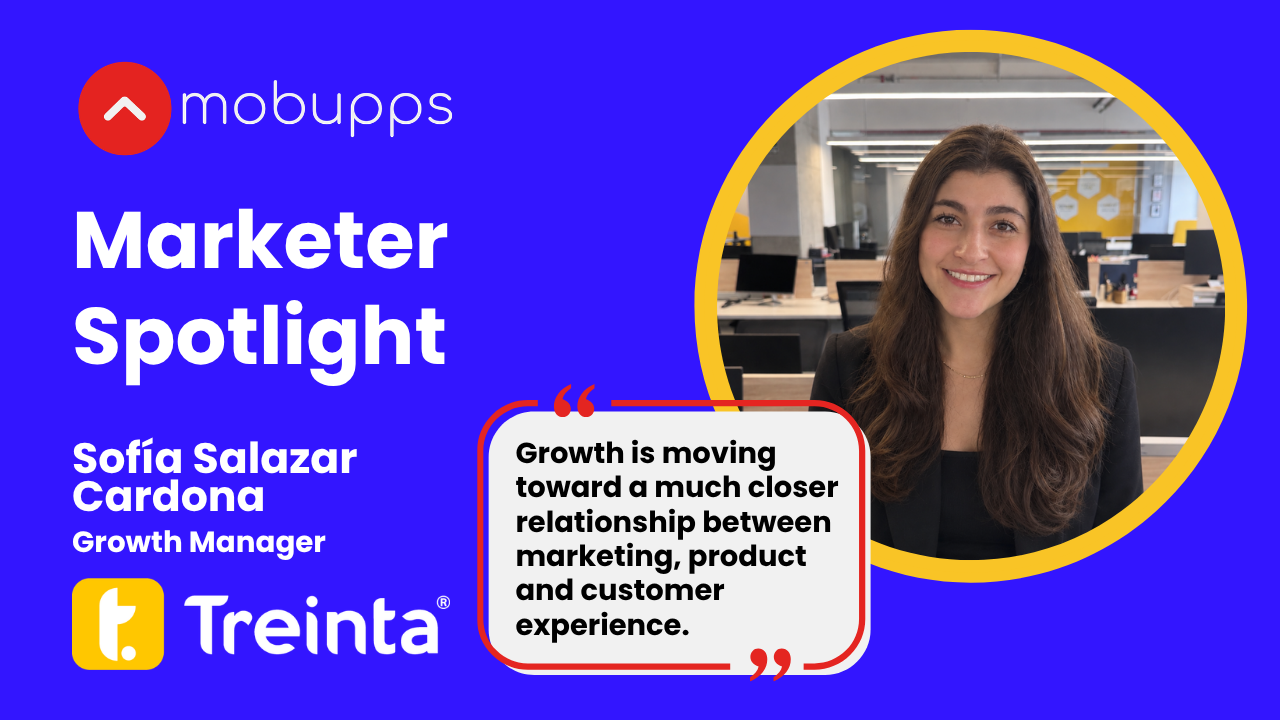
For our sixth edition, we’re excited to feature Sofía Salazar Cardona, Growth Manager at Treinta, a Bogotá, Colombia-based fintech app, designed for micro, small, and medium-sized enterprises (MSMEs).
In this edition, Sofia shares her perspective on activation and retention, the role of AI in growth marketing, the relationship between marketing, product and customer experience.
Let’s dive into the insights from someone who’s not just adapting to the pace of the industry, but actively helping define how fintech marketing evolves in Latin America and beyond.
Answer: I don’t think the answer is to find a single “best” channel. The right question is how each channel contributes to the overall customer journey and whether it creates incremental value. Programmatic, social, in-app, mobile web, CTV and other channels can all play different roles, from discovery to consideration to conversion. What matters is having a clear hypothesis for each investment, measuring its contribution beyond surface-level metrics, and being willing to reallocate quickly when the evidence tells you something different.
Answer: AI is changing the speed and scale at which marketers can operate, but I don’t think it replaces strategic thinking. It can help us identify patterns, generate hypotheses, personalize experiences, and optimize campaigns far faster than before. The bigger shift is that marketers can spend less time on repetitive execution and more time asking better questions. The competitive advantage will belong to teams that know how to combine AI-driven intelligence with human judgment, creativity, and a deep understanding of their users.
Answer: Media quality has to be treated as part of growth strategy, not as a technical issue that comes later. A click, install or conversion only matters if it represents genuine user intent and has the potential to create value. That means looking beyond volume and evaluating traffic quality, publisher signals, engagement patterns and downstream behavior. As acquisition becomes more automated, the ability to distinguish activity from real demand will become increasingly important for every growth team.
Answer: Activation is about reaching the moment when the product stops being an app someone downloaded and becomes a tool they actually rely on. That moment can be different for every user, so growth teams need to understand the behaviors that correlate with long-term value. From there, onboarding, product communication and lifecycle engagement should reinforce those behaviors. For a product like Treinta, where users can manage sales, expenses, inventory and business performance, retention ultimately comes from becoming part of the entrepreneur’s daily operating rhythm.
Answer: I think growth is moving toward a much closer relationship between marketing, product and customer experience. The old separation between “acquiring the user” and “serving the user” is becoming increasingly difficult to defend. The strongest teams will use acquisition data to improve the product, product behavior to improve marketing, and customer insights to shape both. Ultimately, sustainable growth comes when the product itself creates a reason for users to stay, return and recommend it-not when marketing has to constantly convince them to do so.
If you want to be the next Marketer Spotlight or you wish to nominate your leader, feel free to fill out the form.
Welcome to Marketer Spotlight, a conversation series where we connect with forward-thinking leaders from the worlds of marketing, growth, and advertising to explore bold ideas, uncover emerging trends, and gain expert perspectives that are actively shaping the future of our industry. Our goal is to inspire thoughtful dialogue around innovation, strategy, and the evolving role of marketers in a digital-first world.
For our sixth edition, we’re excited to feature Sofía Salazar Cardona, Growth Manager at Treinta, a Bogotá, Colombia-based fintech app, designed for micro, small, and medium-sized enterprises (MSMEs).
In this edition, Sofia shares her perspective on activation and retention, the role of AI in growth marketing, the relationship between marketing, product and customer experience.
Let’s dive into the insights from someone who’s not just adapting to the pace of the industry, but actively helping define how fintech marketing evolves in Latin America and beyond.
Answer: I don’t think the answer is to find a single “best” channel. The right question is how each channel contributes to the overall customer journey and whether it creates incremental value. Programmatic, social, in-app, mobile web, CTV and other channels can all play different roles, from discovery to consideration to conversion. What matters is having a clear hypothesis for each investment, measuring its contribution beyond surface-level metrics, and being willing to reallocate quickly when the evidence tells you something different.
Answer: AI is changing the speed and scale at which marketers can operate, but I don’t think it replaces strategic thinking. It can help us identify patterns, generate hypotheses, personalize experiences, and optimize campaigns far faster than before. The bigger shift is that marketers can spend less time on repetitive execution and more time asking better questions. The competitive advantage will belong to teams that know how to combine AI-driven intelligence with human judgment, creativity, and a deep understanding of their users.
Answer: Media quality has to be treated as part of growth strategy, not as a technical issue that comes later. A click, install or conversion only matters if it represents genuine user intent and has the potential to create value. That means looking beyond volume and evaluating traffic quality, publisher signals, engagement patterns and downstream behavior. As acquisition becomes more automated, the ability to distinguish activity from real demand will become increasingly important for every growth team.
Answer: Activation is about reaching the moment when the product stops being an app someone downloaded and becomes a tool they actually rely on. That moment can be different for every user, so growth teams need to understand the behaviors that correlate with long-term value. From there, onboarding, product communication and lifecycle engagement should reinforce those behaviors. For a product like Treinta, where users can manage sales, expenses, inventory and business performance, retention ultimately comes from becoming part of the entrepreneur’s daily operating rhythm.
Answer: I think growth is moving toward a much closer relationship between marketing, product and customer experience. The old separation between “acquiring the user” and “serving the user” is becoming increasingly difficult to defend. The strongest teams will use acquisition data to improve the product, product behavior to improve marketing, and customer insights to shape both. Ultimately, sustainable growth comes when the product itself creates a reason for users to stay, return and recommend it-not when marketing has to constantly convince them to do so.
If you want to be the next Marketer Spotlight or you wish to nominate your leader, feel free to fill out the form.