How Does Ad Fraud Influence AI Algorithms to Make the Wrong Decisions?



The greatest strength of AI-powered advertising is its ability to learn continuously. Every impression, click, install, conversion, and purchase becomes another data point that helps algorithms decide where to spend the next advertising dollar. Platforms no longer rely solely on predefined audience segments or manual bidding strategies. Instead, they build dynamic models that identify patterns humans would never recognize and automatically optimize campaigns to generate the best results.
This feedback loop has transformed performance marketing, as well as ad fraud. AI understands patterns, and modern fraudsters understand they need to influence what AI believes is true. Machine learning models don't know whether a conversion came from a genuine customer or a sophisticated bot. They don't recognize fake engagement and can't question attribution because they optimize based on probability.
If a specific inventory source repeatedly produces lower acquisition costs, higher conversion rates, or stronger engagement signals, the algorithm naturally allocates more budget there. The problem arises when those signals are artificially manufactured. Unlike human media buyers, algorithms don't ask: “Does this traffic actually make sense?” They ask: “Which signals maximize my optimization objective?” This creates an entirely new attack surface.
Instead of simply generating fake clicks to earn advertising revenue, fraudsters increasingly aim to influence the optimization models themselves. Every fabricated signal becomes part of the dataset the AI uses to make future decisions. Over time, these false signals change campaign behavior.
What begins as a few fraudulent conversions can gradually redirect thousands of dollars to low-quality inventory because the optimization engine has learned that those placements appear to perform well.
Mobupps dived into how AI starts learning from fraudulent signals.
One of the defining characteristics of modern advertising is that marketers are giving up more manual operational control in exchange for greater efficiency.
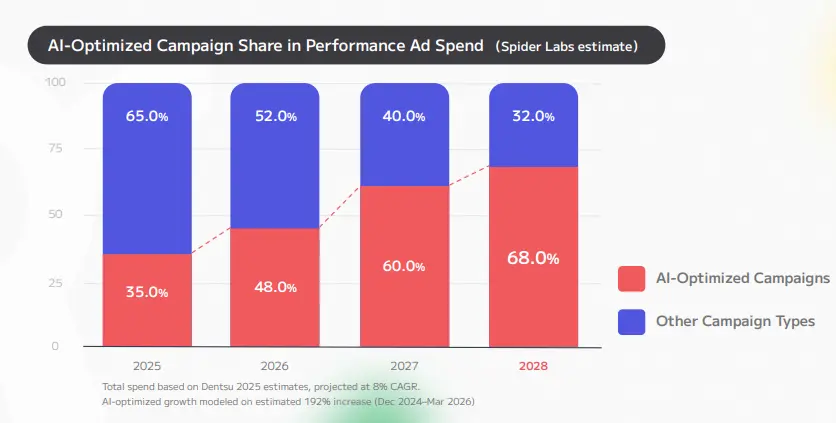
According to the Spider AF Ad Fraud Report, AI-optimized campaign traffic increased by an estimated 192% between December 2024 and March 2026, while traditional campaign structures continued to decline. It is stated that AI-managed campaigns will account for approximately 68% of performance advertising budgets by 2028.
AI optimization capabilities are evolving rapidly. Many companies have invested heavily in automation but continue to measure campaign quality using frameworks developed before AI became responsible for media buying decisions.
Dashboards still emphasize key business metrics such as CPA, CPI, CTR, and ROAS. But they reveal very little about the quality of the signals coming to optimization algorithms. And this is becoming one of the largest operational gaps in performance marketing.
As AI assumes greater responsibility for campaign delivery, advertisers have fewer opportunities to inspect where ads appear or understand why specific optimization decisions are made. Fraudsters increasingly exploit these blind spots by feeding AI systems invalid traffic that appears legitimate during optimization.
Important to mention that we aren't criticizing AI-powered advertising optimization. No doubt, automation has delivered significant performance gains across the industry. The challenge is that optimization engines can only optimize the information they're given. If the learning data is distorted, the optimization process itself becomes unreliable.
Traditional fraud was often easy to spot. Traffic spikes appeared overnight. Bounce rates reached 100%. Conversions never materialized.
Modern fraud rarely behaves this way. Sophisticated fraud aims to remain statistically believable. Click-through rates improve, but not dramatically. CPA declines, but only slightly. Conversion rates increase, but remain within expected benchmarks. Everything appears plausible, and that's intentional.
Sophisticated fraud is designed to blend into high-performing campaigns. In many cases, marketers don't discover the issue until they analyze downstream business metrics such as customer retention, repeat purchases, subscription renewals, or lifetime value.
By then, the optimization engine had already spent weeks reinforcing those patterns. And fraud signals served their purpose.
Perhaps no trend illustrates this better than the rapid growth of Made-for-Advertising (MFA) websites. These properties are designed to monetize advertising inventory.
Advances in generative AI have dramatically accelerated their production. Entire networks of websites can now publish thousands of pages of automatically generated content, creating vast amounts of inventory that appears legitimate to automated buying systems.
From an optimization algorithm's perspective, these placements may seem attractive: large inventory, low costs, high availability, and consistent engagement signals. But the problem is that those signals often fail to represent meaningful human attention.
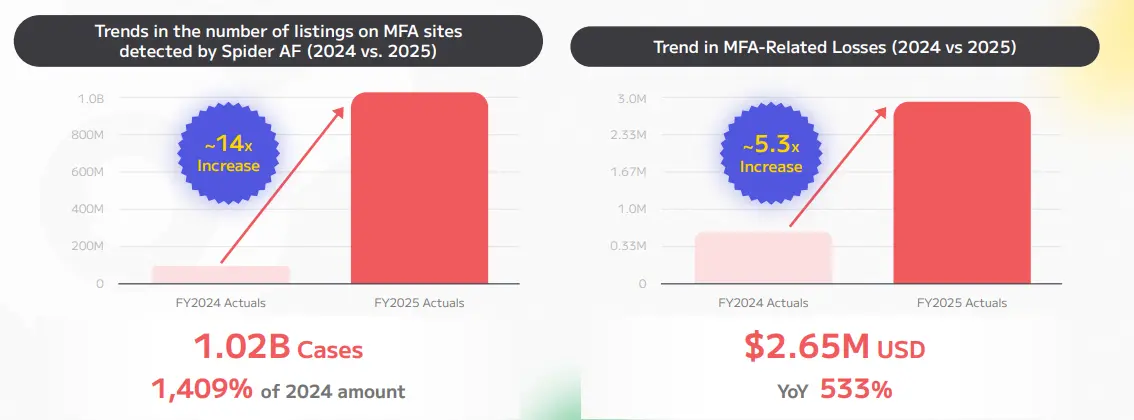
Spider AF's research illustrates how quickly this threat is expanding. The company observed a 14-fold increase in detected MFA placements during 2025, while estimated advertiser losses associated with these sites grew by more than 530% year-over-year. Approximately 62% of those losses originated from AI-optimized campaigns, suggesting automated buying systems are disproportionately impacted by this type of inventory.
This highlights an uncomfortable reality. The system has little reason to distinguish between genuine publisher engagement and artificially inflated performance. AI will buy poor inventory unless marketers introduce independent quality controls.
In an AI-first advertising environment, signal quality is one of the most important KPI marketing leaders should be watching. Signal quality measures whether the data driving optimization accurately represents genuine customer behavior. Poor signal quality creates a closed-loop effect:
We understand how fraud affects AI optimization, but what should marketers actually change? Let's talk about this in the next article.
Finally, we know the algorithm becomes increasingly confident in an increasingly inaccurate model of customer behavior. The quality of decisions will never exceed the data quality that built those decisions. This is why leading companies are beginning to think more about data management.
At Mobupps, we see signal quality as a fundamental part of performance. Our technologies are designed to connect traffic quality, audience intelligence, cross-device signals, attribution, and incrementality so that optimization is driven by meaningful user behavior. We create a reliable environment where trustworthy signals support better optimization, stronger measurement, and more sustainable incremental growth. Explore how Mobupps can help build a more measurable, incremental, and fraud-resilient growth strategy: marketing@mobupps.com
The greatest strength of AI-powered advertising is its ability to learn continuously. Every impression, click, install, conversion, and purchase becomes another data point that helps algorithms decide where to spend the next advertising dollar. Platforms no longer rely solely on predefined audience segments or manual bidding strategies. Instead, they build dynamic models that identify patterns humans would never recognize and automatically optimize campaigns to generate the best results.
This feedback loop has transformed performance marketing, as well as ad fraud. AI understands patterns, and modern fraudsters understand they need to influence what AI believes is true. Machine learning models don't know whether a conversion came from a genuine customer or a sophisticated bot. They don't recognize fake engagement and can't question attribution because they optimize based on probability.
If a specific inventory source repeatedly produces lower acquisition costs, higher conversion rates, or stronger engagement signals, the algorithm naturally allocates more budget there. The problem arises when those signals are artificially manufactured. Unlike human media buyers, algorithms don't ask: “Does this traffic actually make sense?” They ask: “Which signals maximize my optimization objective?” This creates an entirely new attack surface.
Instead of simply generating fake clicks to earn advertising revenue, fraudsters increasingly aim to influence the optimization models themselves. Every fabricated signal becomes part of the dataset the AI uses to make future decisions. Over time, these false signals change campaign behavior.
What begins as a few fraudulent conversions can gradually redirect thousands of dollars to low-quality inventory because the optimization engine has learned that those placements appear to perform well.
Mobupps dived into how AI starts learning from fraudulent signals.
One of the defining characteristics of modern advertising is that marketers are giving up more manual operational control in exchange for greater efficiency.
According to the Spider AF Ad Fraud Report, AI-optimized campaign traffic increased by an estimated 192% between December 2024 and March 2026, while traditional campaign structures continued to decline. It is stated that AI-managed campaigns will account for approximately 68% of performance advertising budgets by 2028.
AI optimization capabilities are evolving rapidly. Many companies have invested heavily in automation but continue to measure campaign quality using frameworks developed before AI became responsible for media buying decisions.
Dashboards still emphasize key business metrics such as CPA, CPI, CTR, and ROAS. But they reveal very little about the quality of the signals coming to optimization algorithms. And this is becoming one of the largest operational gaps in performance marketing.
As AI assumes greater responsibility for campaign delivery, advertisers have fewer opportunities to inspect where ads appear or understand why specific optimization decisions are made. Fraudsters increasingly exploit these blind spots by feeding AI systems invalid traffic that appears legitimate during optimization.
Important to mention that we aren't criticizing AI-powered advertising optimization. No doubt, automation has delivered significant performance gains across the industry. The challenge is that optimization engines can only optimize the information they're given. If the learning data is distorted, the optimization process itself becomes unreliable.
Traditional fraud was often easy to spot. Traffic spikes appeared overnight. Bounce rates reached 100%. Conversions never materialized.
Modern fraud rarely behaves this way. Sophisticated fraud aims to remain statistically believable. Click-through rates improve, but not dramatically. CPA declines, but only slightly. Conversion rates increase, but remain within expected benchmarks. Everything appears plausible, and that's intentional.
Sophisticated fraud is designed to blend into high-performing campaigns. In many cases, marketers don't discover the issue until they analyze downstream business metrics such as customer retention, repeat purchases, subscription renewals, or lifetime value.
By then, the optimization engine had already spent weeks reinforcing those patterns. And fraud signals served their purpose.
Perhaps no trend illustrates this better than the rapid growth of Made-for-Advertising (MFA) websites. These properties are designed to monetize advertising inventory.
Advances in generative AI have dramatically accelerated their production. Entire networks of websites can now publish thousands of pages of automatically generated content, creating vast amounts of inventory that appears legitimate to automated buying systems.
From an optimization algorithm's perspective, these placements may seem attractive: large inventory, low costs, high availability, and consistent engagement signals. But the problem is that those signals often fail to represent meaningful human attention.
Spider AF's research illustrates how quickly this threat is expanding. The company observed a 14-fold increase in detected MFA placements during 2025, while estimated advertiser losses associated with these sites grew by more than 530% year-over-year. Approximately 62% of those losses originated from AI-optimized campaigns, suggesting automated buying systems are disproportionately impacted by this type of inventory.
This highlights an uncomfortable reality. The system has little reason to distinguish between genuine publisher engagement and artificially inflated performance. AI will buy poor inventory unless marketers introduce independent quality controls.
In an AI-first advertising environment, signal quality is one of the most important KPI marketing leaders should be watching. Signal quality measures whether the data driving optimization accurately represents genuine customer behavior. Poor signal quality creates a closed-loop effect:
We understand how fraud affects AI optimization, but what should marketers actually change? Let's talk about this in the next article.
Finally, we know the algorithm becomes increasingly confident in an increasingly inaccurate model of customer behavior. The quality of decisions will never exceed the data quality that built those decisions. This is why leading companies are beginning to think more about data management.
At Mobupps, we see signal quality as a fundamental part of performance. Our technologies are designed to connect traffic quality, audience intelligence, cross-device signals, attribution, and incrementality so that optimization is driven by meaningful user behavior. We create a reliable environment where trustworthy signals support better optimization, stronger measurement, and more sustainable incremental growth. Explore how Mobupps can help build a more measurable, incremental, and fraud-resilient growth strategy: marketing@mobupps.com