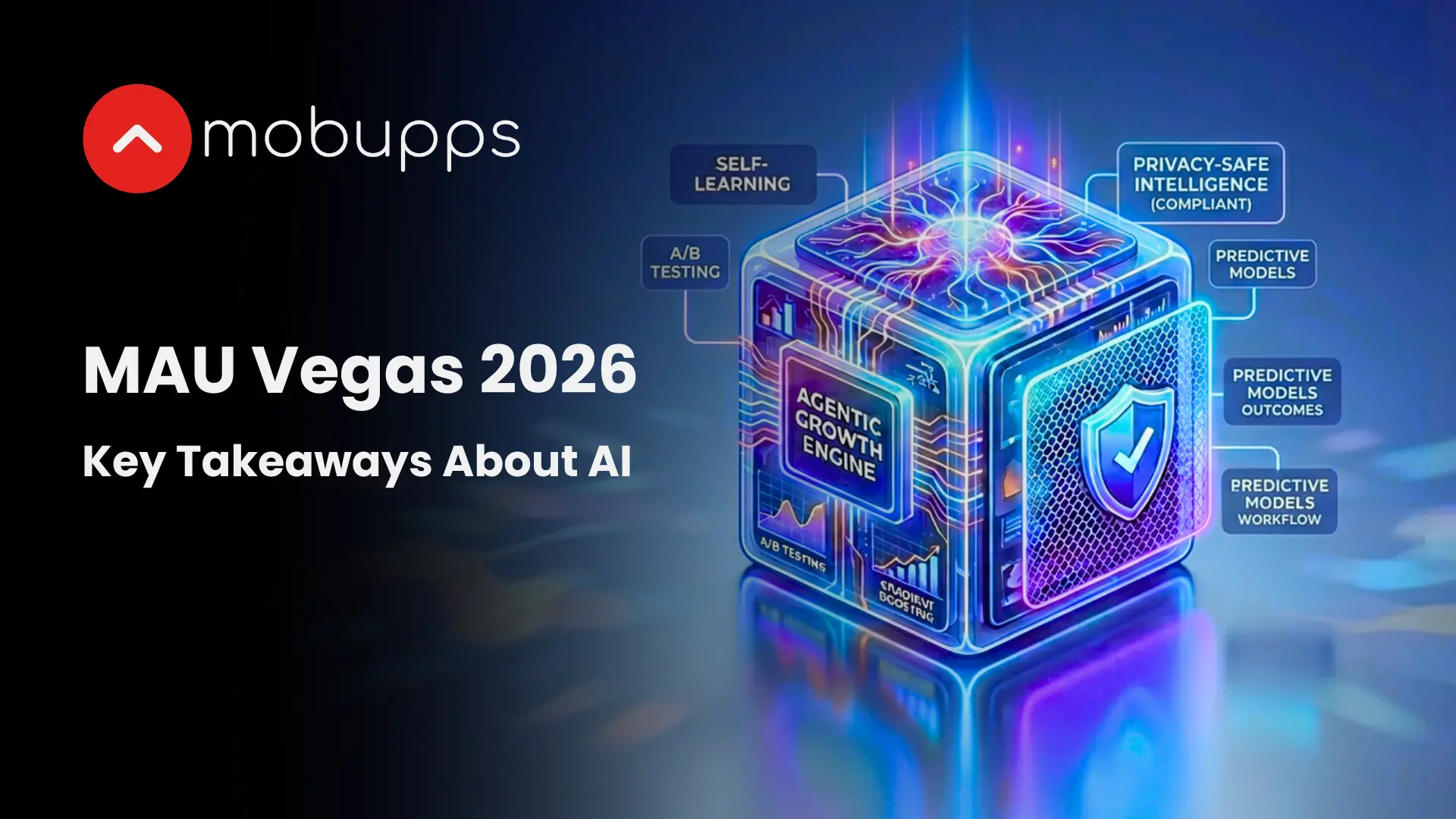
Hearing the sessions from the main stage at MAU Vegas 2026, one thing became immediately clear: AI isn't discussed as a supporting tool for marketing. It is becoming the infrastructure behind the growth operations, decision-making, and scaling.
For years, the industry talked about AI meaning faster reporting, smarter targeting, and automated optimization. But the speeches at MAU Vegas highlighted a much bigger shift. Agentic AI, privacy-safe infrastructure, predictive experimentation, and real-time acquisition intelligence - the market is searching for systems that can continuously learn, adapt, and act with minimal manual intervention. We exchanged opinions on how AI can redefine these processes across the entire adtech industry. Three themes stood out to me at this event.
One of the strongest signals from MAU Vegas was the emergence of what many speakers described as the “agentic” in marketing. Instead of manually managing hundreds of disconnected decisions, AI systems are increasingly capable of interpreting signals, making recommendations, and executing optimizations in real time.
This shift matters because modern growth environments have become too fragmented for reactive decision-making. Mobile, web, CTV, retail media, and programmatic - all generate enormous volumes of behavioral data, yet most teams still operate across disconnected dashboards and workflows. And the challenge is turning data into actionable intelligence fast enough to create a competitive advantage.
At Mobupps, this is exactly the thinking behind our self-learning recommendation engine, designed to unify signals across channels and continuously optimize campaigns based on real-time performance patterns. It identifies value and adapts dynamically to deliver stronger user lifetime value and lower acquisition costs with minimal manual input.
After the conference, I confirmed my prediction that the next generation of AI platforms will function as decision engines: identifying incremental value, predicting performance shifts, detecting inefficiencies early, and recommending actions before marketers even recognize a problem.
Another major theme across MAU Vegas discussions was the growing importance of predictive infrastructure. Historically, performance marketing has been largely retrospective. Teams analyze campaign results after delivery, identify what worked, and then manually iterate. But that model is inefficient when acquisition costs fluctuate rapidly and user behavior changes constantly.
Sessions focused on experimentation, AI-driven testing, and mobile app operations highlighted how machine learning is accelerating the entire optimization cycle. Instead of waiting days or weeks for enough data to validate assumptions, AI systems can identify early performance signals and dynamically reallocate budgets, audiences, and creative strategies.
Marketers are under growing pressure to prove incrementality and distinguish true net-new growth from overlapping exposure or artificial performance inflation. Attribution models become more complex, and privacy changes continue to limit measurement.
In those conditions, advanced models are leveraged to identify genuine full-funnel impact, connect acquisition performance with downstream lifetime value, retention behavior, and monetization patterns that humans simply can't process fast enough at scale.
Remember: Success is measured by efficiency, sustainability, and predictive accuracy.
Privacy was another dominant theme at MAU Vegas, but the tone of the conversation has changed significantly compared to previous years. The growing recognition is that privacy constraints are accelerating the need for more intelligent systems.
Moreover, AI and privacy are no longer opposing forces. Deterministic identifiers become more limited, and marketers require technologies to extract value from fragmented and probabilistic signals. These AI models have to unify behavioral patterns across environments while remaining compliant with evolving privacy standards.
In the future, everybody will be balancing three priorities simultaneously: automation, measurement accuracy, and privacy-safe intelligence. This is relevant in mobile growth, where we increasingly operate across multiple circumstances with incomplete visibility into user journeys. AI-driven infrastructure can help bridge these gaps by analyzing contextual, behavioral, and predictive signals collectively.
This conversation at MAU showed that marketers are much more focused on evaluating AI capabilities for achieving measurable operational outcomes, such as acquisition costs, improved incrementality, and shortened optimization cycles.
The biggest takeaway from MAU Vegas 2026 is that AI will become deeply embedded in all business growth infrastructure, influencing every launched, optimized, measured, and scaled campaign across every channel.
Hearing the sessions from the main stage at MAU Vegas 2026, one thing became immediately clear: AI isn't discussed as a supporting tool for marketing. It is becoming the infrastructure behind the growth operations, decision-making, and scaling.
For years, the industry talked about AI meaning faster reporting, smarter targeting, and automated optimization. But the speeches at MAU Vegas highlighted a much bigger shift. Agentic AI, privacy-safe infrastructure, predictive experimentation, and real-time acquisition intelligence - the market is searching for systems that can continuously learn, adapt, and act with minimal manual intervention. We exchanged opinions on how AI can redefine these processes across the entire adtech industry. Three themes stood out to me at this event.
One of the strongest signals from MAU Vegas was the emergence of what many speakers described as the “agentic” in marketing. Instead of manually managing hundreds of disconnected decisions, AI systems are increasingly capable of interpreting signals, making recommendations, and executing optimizations in real time.
This shift matters because modern growth environments have become too fragmented for reactive decision-making. Mobile, web, CTV, retail media, and programmatic - all generate enormous volumes of behavioral data, yet most teams still operate across disconnected dashboards and workflows. And the challenge is turning data into actionable intelligence fast enough to create a competitive advantage.
At Mobupps, this is exactly the thinking behind our self-learning recommendation engine, designed to unify signals across channels and continuously optimize campaigns based on real-time performance patterns. It identifies value and adapts dynamically to deliver stronger user lifetime value and lower acquisition costs with minimal manual input.
After the conference, I confirmed my prediction that the next generation of AI platforms will function as decision engines: identifying incremental value, predicting performance shifts, detecting inefficiencies early, and recommending actions before marketers even recognize a problem.
Another major theme across MAU Vegas discussions was the growing importance of predictive infrastructure. Historically, performance marketing has been largely retrospective. Teams analyze campaign results after delivery, identify what worked, and then manually iterate. But that model is inefficient when acquisition costs fluctuate rapidly and user behavior changes constantly.
Sessions focused on experimentation, AI-driven testing, and mobile app operations highlighted how machine learning is accelerating the entire optimization cycle. Instead of waiting days or weeks for enough data to validate assumptions, AI systems can identify early performance signals and dynamically reallocate budgets, audiences, and creative strategies.
Marketers are under growing pressure to prove incrementality and distinguish true net-new growth from overlapping exposure or artificial performance inflation. Attribution models become more complex, and privacy changes continue to limit measurement.
In those conditions, advanced models are leveraged to identify genuine full-funnel impact, connect acquisition performance with downstream lifetime value, retention behavior, and monetization patterns that humans simply can't process fast enough at scale.
Remember: Success is measured by efficiency, sustainability, and predictive accuracy.
Privacy was another dominant theme at MAU Vegas, but the tone of the conversation has changed significantly compared to previous years. The growing recognition is that privacy constraints are accelerating the need for more intelligent systems.
Moreover, AI and privacy are no longer opposing forces. Deterministic identifiers become more limited, and marketers require technologies to extract value from fragmented and probabilistic signals. These AI models have to unify behavioral patterns across environments while remaining compliant with evolving privacy standards.
In the future, everybody will be balancing three priorities simultaneously: automation, measurement accuracy, and privacy-safe intelligence. This is relevant in mobile growth, where we increasingly operate across multiple circumstances with incomplete visibility into user journeys. AI-driven infrastructure can help bridge these gaps by analyzing contextual, behavioral, and predictive signals collectively.
This conversation at MAU showed that marketers are much more focused on evaluating AI capabilities for achieving measurable operational outcomes, such as acquisition costs, improved incrementality, and shortened optimization cycles.
The biggest takeaway from MAU Vegas 2026 is that AI will become deeply embedded in all business growth infrastructure, influencing every launched, optimized, measured, and scaled campaign across every channel.