From Kickoff to Conversion: The Cross-Device Strategy for FIFA 2026


The World’s Biggest Sporting Event Is Becoming the World’s Biggest Growth Opportunity
Every few years, a sporting event transcends sport itself and becomes a global cultural phenomenon. FIFA World Cup 2026 is poised to be exactly that. Expanded to 48 teams, 104 matches, and hosted across the United States, Canada, and Mexico, the tournament is projected to attract more than five billion viewers worldwide.
For marketers, however, the World Cup represents far more than audience reach. It is one of the largest concentration points of consumer attention, engagement, and purchase intent that exists anywhere in the digital ecosystem.
Yet the way fans experience football today looks dramatically different from previous tournaments. The modern football fan no longer sits in front of a single television screen for ninety minutes. Instead, they move seamlessly between Connected TV, OTT platforms, smartphones, tablets, social media, gaming apps, betting platforms, e-commerce experiences, and digital wallets.
This shift has transformed the World Cup from a broadcast event into a cross-device consumer journey. For brands and app marketers across the United States and Europe, success during FIFA World Cup 2026 will depend not on how many impressions they buy, but on how effectively they connect, measure, and optimize those journeys.
A Once-in-a-Generation Digital Growth Moment
The scale of FIFA World Cup 2026 is unlike anything the advertising industry has seen before. With 104 matches played over approximately 39 days, the tournament creates an extended period of heightened consumer engagement rather than a short-lived spike.
History suggests that mobile behavior changes significantly during major football tournaments. Previous World Cup events saw streaming app installs increase by 46% on opening day, sports news app downloads rise by 72%, and betting app installs grow by 57%. Across the broader sports category, download growth during World Cup periods has reached as high as 290%, according to AppMagic market intelligence.
What makes FIFA World Cup 2026 even more significant is its geographic footprint. While hosted in North America, Europe remains one of the most commercially valuable audiences due to its deep football culture, mature digital ecosystem, and high consumer spending power. For brands operating across both regions, this creates a rare opportunity to activate campaigns simultaneously across two of the world’s largest advertising markets.
The Modern Football Fan Lives Across Multiple Screens
The traditional customer journey no longer exists during major sporting events. A football fan may discover a brand while watching a match on Connected TV, engage with related content on social media during halftime, browse offers on a mobile device after the match, and complete a purchase later from a desktop computer.
Research indicates that approximately 75% of sports viewers engage with a second screen while watching live sports, while social engagement during FIFA World Cup 2022 increased by more than 600% compared to previous tournaments. This behavior creates enormous opportunity, but also enormous complexity.
Without cross-device intelligence, marketers struggle with fragmented customer journeys, duplicated audiences, inefficient frequency management, and incomplete attribution. The result is often an inaccurate understanding of which channels are genuinely driving business outcomes. The brands that win during FIFA World Cup 2026 will be the ones capable of seeing the entire customer journey rather than isolated touchpoints.
Why Cross-Device Intelligence Becomes the Competitive Advantage
Football moments create unique consumer behaviors that unfold in real time. User intent fluctuates before kickoff, during live play, at halftime, and immediately after key match moments. This creates hundreds of micro-opportunities for marketers to engage consumers at exactly the right time.
Mobupps’ performance infrastructure, powered by MAFO’s AI-driven optimization engine, enables advertisers to activate campaigns across Connected TV, mobile, web, OEM environments, and programmatic channels through a unified execution layer. Rather than treating devices as independent environments, MAFO connects audience signals across screens, enabling brands to understand how engagement on one device influences actions on another.
This approach allows marketers to build a continuous customer journey that follows fan behavior rather than forcing consumers into channel-specific silos. As football audiences move fluidly between screens, advertising strategies must do the same.
From Audience Data to Audience Intelligence
Not all football fans behave alike.Some engage only during major matches. Others follow every fixture, consume highlights, interact on social media, participate in fantasy leagues, or make purchases related to teams and players.
The challenge for marketers is turning this passion into actionable performance signals.
Through advanced audience intelligence capabilities, Mobupps enables brands to segment audiences based on behavioral engagement, contextual signals, purchase intent, regional preferences, and cross-device activity. This creates a shift from broad football targeting to precision audience activation.
A highly engaged supporter browsing match statistics before kickoff represents a very different opportunity than a casual viewer engaging only during tournament finals. Understanding these nuances allows advertisers to align messaging, creative formats, and bidding strategies with actual user intent. During live sporting moments, relevance becomes a performance multiplier.
The Measurement Gap Most Advertisers Miss
One of the most misunderstood realities of football marketing is that performance often extends beyond what traditional measurement models can see. Sports apps and gaming platforms typically experience immediate spikes in installs and engagement. However, categories such as fintech, e-commerce, travel, and entertainment frequently appear to generate weaker results.
The reality is more complicated. Football often drives upper-funnel discovery on Connected TV, social media, and mobile channels while conversions occur later on entirely different devices. Traditional last-touch attribution frequently fails to capture these assisted interactions, causing marketers to undervalue influential channels.
This is where Singular’s advanced measurement framework becomes critical. By combining cross-device measurement, multi-touch attribution, and incrementality analysis, Singular enables marketers to understand not only where conversions happened, but why they happened.
Research based on billions of clicks, installs, and impressions has shown that channels traditionally viewed as awareness drivers can generate significantly more value than last-touch models suggest. In some cases, measured ROAS increases by up to 50% when multi-touch attribution is applied. During high-attention events like the World Cup, that visibility becomes a competitive advantage.
Turning Football Passion Into Measurable Growth
The most successful FIFA World Cup campaigns will not be defined by reach alone. They will be defined by how effectively brands connect attention, engagement, and conversion across the entire customer journey. The combined framework of Mobupps, MAFO, Singular, AppMagic, and MGA provides exactly that capability.
AppMagic delivers category intelligence and market benchmarking. Singular connects fragmented journeys through advanced attribution and measurement. MAFO transforms audience signals into actionable optimization decisions. Mobupps activates campaigns across premium media environments with real-time precision. Together, these capabilities create a growth engine designed for modern sporting moments.
The Future of Football Advertising Starts Here
FIFA World Cup 2026 represents more than a tournament. It represents the future of advertising itself. A future where consumers engage across multiple screens simultaneously. A future where attribution must evolve beyond last-click measurement. A future where real-time optimization, audience intelligence, and cross-device visibility determine who wins.
For brands and app marketers across the United States and Europe, the opportunity is clear.
The winners of FIFA World Cup 2026 will not simply capture attention. They will understand the journey behind it, measure its true impact, and turn every moment of football passion into sustainable business growth. Because in today’s digital world, winning the football moment means winning every screen that surrounds it.
Read the full report to unlock the cross‑device strategies, attribution frameworks, and real-time optimization models shaping the future of football advertising.
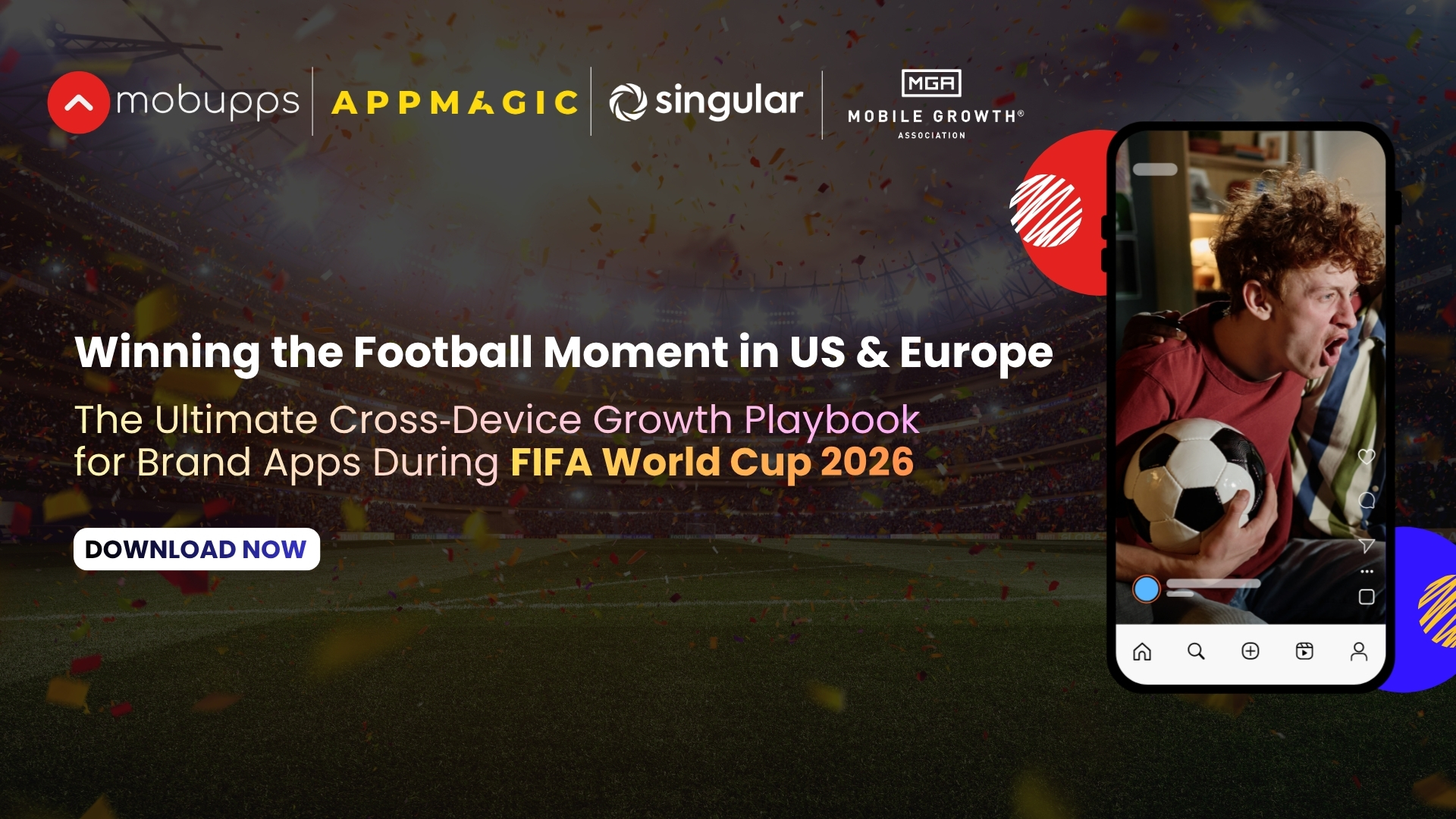
Winning the Football Moment in US & Europe : The Ultimate Cross-Device Growth Playbook for Brand Apps During FIFA World Cup 2026
(In Partnership with AppMagic, Singular & Mobile Growth Association)
The World’s Biggest Sporting Event Is Becoming the World’s Biggest Growth Opportunity
Every few years, a sporting event transcends sport itself and becomes a global cultural phenomenon. FIFA World Cup 2026 is poised to be exactly that. Expanded to 48 teams, 104 matches, and hosted across the United States, Canada, and Mexico, the tournament is projected to attract more than five billion viewers worldwide.
For marketers, however, the World Cup represents far more than audience reach. It is one of the largest concentration points of consumer attention, engagement, and purchase intent that exists anywhere in the digital ecosystem.
Yet the way fans experience football today looks dramatically different from previous tournaments. The modern football fan no longer sits in front of a single television screen for ninety minutes. Instead, they move seamlessly between Connected TV, OTT platforms, smartphones, tablets, social media, gaming apps, betting platforms, e-commerce experiences, and digital wallets.
This shift has transformed the World Cup from a broadcast event into a cross-device consumer journey. For brands and app marketers across the United States and Europe, success during FIFA World Cup 2026 will depend not on how many impressions they buy, but on how effectively they connect, measure, and optimize those journeys.
A Once-in-a-Generation Digital Growth Moment
The scale of FIFA World Cup 2026 is unlike anything the advertising industry has seen before. With 104 matches played over approximately 39 days, the tournament creates an extended period of heightened consumer engagement rather than a short-lived spike.
History suggests that mobile behavior changes significantly during major football tournaments. Previous World Cup events saw streaming app installs increase by 46% on opening day, sports news app downloads rise by 72%, and betting app installs grow by 57%. Across the broader sports category, download growth during World Cup periods has reached as high as 290%, according to AppMagic market intelligence.
What makes FIFA World Cup 2026 even more significant is its geographic footprint. While hosted in North America, Europe remains one of the most commercially valuable audiences due to its deep football culture, mature digital ecosystem, and high consumer spending power. For brands operating across both regions, this creates a rare opportunity to activate campaigns simultaneously across two of the world’s largest advertising markets.
The Modern Football Fan Lives Across Multiple Screens
The traditional customer journey no longer exists during major sporting events. A football fan may discover a brand while watching a match on Connected TV, engage with related content on social media during halftime, browse offers on a mobile device after the match, and complete a purchase later from a desktop computer.
Research indicates that approximately 75% of sports viewers engage with a second screen while watching live sports, while social engagement during FIFA World Cup 2022 increased by more than 600% compared to previous tournaments. This behavior creates enormous opportunity, but also enormous complexity.
Without cross-device intelligence, marketers struggle with fragmented customer journeys, duplicated audiences, inefficient frequency management, and incomplete attribution. The result is often an inaccurate understanding of which channels are genuinely driving business outcomes. The brands that win during FIFA World Cup 2026 will be the ones capable of seeing the entire customer journey rather than isolated touchpoints.
Why Cross-Device Intelligence Becomes the Competitive Advantage
Football moments create unique consumer behaviors that unfold in real time. User intent fluctuates before kickoff, during live play, at halftime, and immediately after key match moments. This creates hundreds of micro-opportunities for marketers to engage consumers at exactly the right time.
Mobupps’ performance infrastructure, powered by MAFO’s AI-driven optimization engine, enables advertisers to activate campaigns across Connected TV, mobile, web, OEM environments, and programmatic channels through a unified execution layer. Rather than treating devices as independent environments, MAFO connects audience signals across screens, enabling brands to understand how engagement on one device influences actions on another.
This approach allows marketers to build a continuous customer journey that follows fan behavior rather than forcing consumers into channel-specific silos. As football audiences move fluidly between screens, advertising strategies must do the same.
From Audience Data to Audience Intelligence
Not all football fans behave alike.Some engage only during major matches. Others follow every fixture, consume highlights, interact on social media, participate in fantasy leagues, or make purchases related to teams and players.
The challenge for marketers is turning this passion into actionable performance signals.
Through advanced audience intelligence capabilities, Mobupps enables brands to segment audiences based on behavioral engagement, contextual signals, purchase intent, regional preferences, and cross-device activity. This creates a shift from broad football targeting to precision audience activation.
A highly engaged supporter browsing match statistics before kickoff represents a very different opportunity than a casual viewer engaging only during tournament finals. Understanding these nuances allows advertisers to align messaging, creative formats, and bidding strategies with actual user intent. During live sporting moments, relevance becomes a performance multiplier.
The Measurement Gap Most Advertisers Miss
One of the most misunderstood realities of football marketing is that performance often extends beyond what traditional measurement models can see. Sports apps and gaming platforms typically experience immediate spikes in installs and engagement. However, categories such as fintech, e-commerce, travel, and entertainment frequently appear to generate weaker results.
The reality is more complicated. Football often drives upper-funnel discovery on Connected TV, social media, and mobile channels while conversions occur later on entirely different devices. Traditional last-touch attribution frequently fails to capture these assisted interactions, causing marketers to undervalue influential channels.
This is where Singular’s advanced measurement framework becomes critical. By combining cross-device measurement, multi-touch attribution, and incrementality analysis, Singular enables marketers to understand not only where conversions happened, but why they happened.
Research based on billions of clicks, installs, and impressions has shown that channels traditionally viewed as awareness drivers can generate significantly more value than last-touch models suggest. In some cases, measured ROAS increases by up to 50% when multi-touch attribution is applied. During high-attention events like the World Cup, that visibility becomes a competitive advantage.
Turning Football Passion Into Measurable Growth
The most successful FIFA World Cup campaigns will not be defined by reach alone. They will be defined by how effectively brands connect attention, engagement, and conversion across the entire customer journey. The combined framework of Mobupps, MAFO, Singular, AppMagic, and MGA provides exactly that capability.
AppMagic delivers category intelligence and market benchmarking. Singular connects fragmented journeys through advanced attribution and measurement. MAFO transforms audience signals into actionable optimization decisions. Mobupps activates campaigns across premium media environments with real-time precision. Together, these capabilities create a growth engine designed for modern sporting moments.
The Future of Football Advertising Starts Here
FIFA World Cup 2026 represents more than a tournament. It represents the future of advertising itself. A future where consumers engage across multiple screens simultaneously. A future where attribution must evolve beyond last-click measurement. A future where real-time optimization, audience intelligence, and cross-device visibility determine who wins.
For brands and app marketers across the United States and Europe, the opportunity is clear.
The winners of FIFA World Cup 2026 will not simply capture attention. They will understand the journey behind it, measure its true impact, and turn every moment of football passion into sustainable business growth. Because in today’s digital world, winning the football moment means winning every screen that surrounds it.
Read the full report to unlock the cross‑device strategies, attribution frameworks, and real-time optimization models shaping the future of football advertising.
Winning the Football Moment in US & Europe : The Ultimate Cross-Device Growth Playbook for Brand Apps During FIFA World Cup 2026
(In Partnership with AppMagic, Singular & Mobile Growth Association)