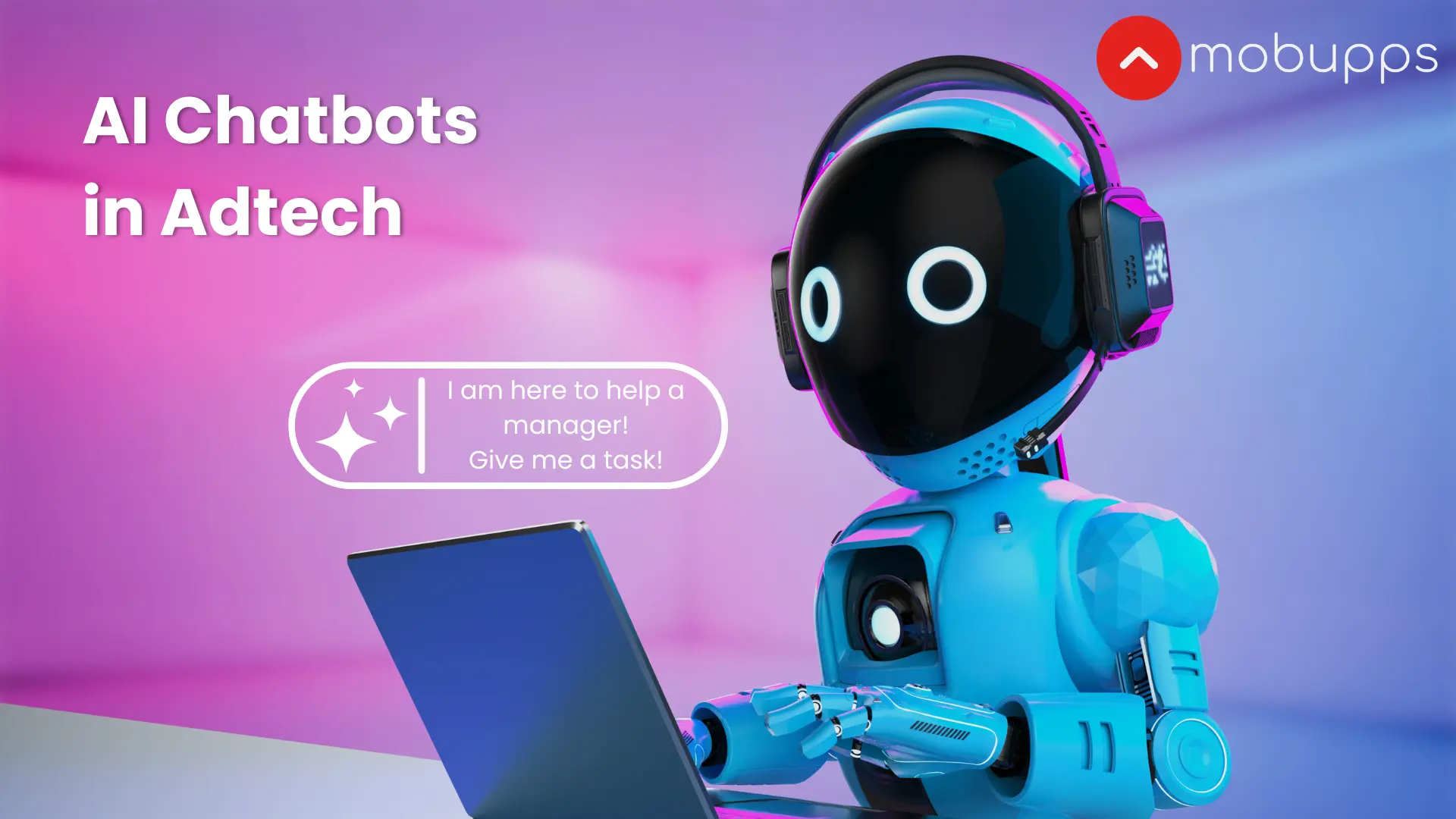
Data is only as good as the speed at which you can use it. Just imagine, a 10-minute delay in adjusting a bid can cost thousands.
When datasets grow into massive multi-tab reports, the pressure on human teams to extract instant insights has reached a breaking point. Therefore, internal AI chatbots have moved from a nice-to-have to a mission-critical.
But despite their growing importance, one misconception persists: that AI can replace human expertise. The reality is quite the opposite. Mobupps is going to prove how AI-powered chatbots are impacting the workplace and the quality of insights.
AI chatbots are becoming indispensable tools in the adtech industry. But despite their capabilities, they still fall short of fully replacing humans. Here’s why.
Creative Intuition and Emotional Nuance
At its core, AI operates on probability rather than true understanding or empathy. While chatbots can replicate tone, style, and language, they don’t actually feel anything. This distinction matters more than it might seem. Humans bring a level of creative intuition that goes beyond data. For example, AI might identify that a blue banner performs better than a red one. But understanding why that specific shade resonates, whether it evokes nostalgia, trust, or cultural symbolism, requires lived experience and emotional depth.
Cultural context further complicates things. Language, humor, and social norms evolve rapidly, often in ways that aren’t immediately reflected in training data. As a result, chatbots can miss subtle cues, misunderstand slang, or overlook sensitive cultural nuances that a human would instinctively grasp.
Lack of Total Autonomy
A chatbot is like a high-performance engine without a steering wheel. It is incredibly capable, but entirely reliant on human direction. They don’t initiate ideas on their own. There’s no moment of inspiration, no spontaneous recognition of a market gap, no internal drive to create something new. Every output begins with a prompt.
Maybe you've heard the phrase "Garbage In, Garbage Out." This means that the quality of AI output is directly tied to the quality of human input. A vague, biased, or poorly structured prompt will produce equally flawed results. In other words, AI doesn’t correct bad thinking; it will confidently follow that path.
Before the AI adoption, managers typically spent hours navigating complex spreadsheets and dashboards, manually filtering campaign data and cross-checking multiple sources. This process sometimes was followed by human error, especially when it came to repetitive copy-paste tasks. As a result, insights were often delayed, slowing down optimization and limiting the ability to react in real time.
With AI chatbots, this workflow has changed. Campaign summaries can now be generated instantly through a single query, while top-performing regions and creatives are automatically identified. Budget tracking and performance insights are delivered in real time, allowing managers to focus on strategy.
The impact is measurable:
For example, an Account Manager needs to gather a performance summary of their client's campaign, including results, lists with top-performing regions, and budget spending. The manager has to find everything in a big report with important data. To summarize the insights faster, companies are moving to in-house AI Chatbots.
Public AI tools offer general capabilities. But when a company develops its own AI Chatbot integrated into its own Data Management Platform (DMP), everything changes.
1. Speed with Absolute Security: Internal bots operate entirely within the company’s firewall. When someone asks, “Which creative performed best in this campaign?”, the bot pulls the answer straight from internal databases. The data never leaves the "house", keeping client information 100% protected while delivering insights in seconds.
2. Error-Free Accuracy: Public bots often hallucinate or guess when they don't have specific context. A proprietary bot is trained specifically on your exact logic, specific naming conventions, and KPIs. Because it is mapped to your actual databases, it fetches precise, verified numbers.
3. Evolving Recommendation System: It can analyze past actions across thousands of rows to find the exact sweet spot for bidding that a human eye would miss. Or instead of just showing data, it can suggest: "Budget for Campaign X is under-pacing; I recommend shifting $5,000 from Campaign Y to hit the goal."
AI is great at handling large amounts of data, delivering quick insights, and taking care of repetitive tasks. But when it comes to strategy, creativity, and understanding people, human input is still essential.
At Mobupps, we’re currently testing our proprietary AI chatbot, designed to support managers in their day-to-day work. Even at this stage, we’re seeing real improvements: less time spent digging through data in reports, faster campaign analysis, and smoother decision-making overall. By taking over routine tasks and making insights easier to access, the chatbot gives managers more space to focus on strategy and growing their clients’ results.
Data is only as good as the speed at which you can use it. Just imagine, a 10-minute delay in adjusting a bid can cost thousands.
When datasets grow into massive multi-tab reports, the pressure on human teams to extract instant insights has reached a breaking point. Therefore, internal AI chatbots have moved from a nice-to-have to a mission-critical.
But despite their growing importance, one misconception persists: that AI can replace human expertise. The reality is quite the opposite. Mobupps is going to prove how AI-powered chatbots are impacting the workplace and the quality of insights.
AI chatbots are becoming indispensable tools in the adtech industry. But despite their capabilities, they still fall short of fully replacing humans. Here’s why.
Creative Intuition and Emotional Nuance
At its core, AI operates on probability rather than true understanding or empathy. While chatbots can replicate tone, style, and language, they don’t actually feel anything. This distinction matters more than it might seem. Humans bring a level of creative intuition that goes beyond data. For example, AI might identify that a blue banner performs better than a red one. But understanding why that specific shade resonates, whether it evokes nostalgia, trust, or cultural symbolism, requires lived experience and emotional depth.
Cultural context further complicates things. Language, humor, and social norms evolve rapidly, often in ways that aren’t immediately reflected in training data. As a result, chatbots can miss subtle cues, misunderstand slang, or overlook sensitive cultural nuances that a human would instinctively grasp.
Lack of Total Autonomy
A chatbot is like a high-performance engine without a steering wheel. It is incredibly capable, but entirely reliant on human direction. They don’t initiate ideas on their own. There’s no moment of inspiration, no spontaneous recognition of a market gap, no internal drive to create something new. Every output begins with a prompt.
Maybe you've heard the phrase "Garbage In, Garbage Out." This means that the quality of AI output is directly tied to the quality of human input. A vague, biased, or poorly structured prompt will produce equally flawed results. In other words, AI doesn’t correct bad thinking; it will confidently follow that path.
Before the AI adoption, managers typically spent hours navigating complex spreadsheets and dashboards, manually filtering campaign data and cross-checking multiple sources. This process sometimes was followed by human error, especially when it came to repetitive copy-paste tasks. As a result, insights were often delayed, slowing down optimization and limiting the ability to react in real time.
With AI chatbots, this workflow has changed. Campaign summaries can now be generated instantly through a single query, while top-performing regions and creatives are automatically identified. Budget tracking and performance insights are delivered in real time, allowing managers to focus on strategy.
The impact is measurable:
For example, an Account Manager needs to gather a performance summary of their client's campaign, including results, lists with top-performing regions, and budget spending. The manager has to find everything in a big report with important data. To summarize the insights faster, companies are moving to in-house AI Chatbots.
Public AI tools offer general capabilities. But when a company develops its own AI Chatbot integrated into its own Data Management Platform (DMP), everything changes.
1. Speed with Absolute Security: Internal bots operate entirely within the company’s firewall. When someone asks, “Which creative performed best in this campaign?”, the bot pulls the answer straight from internal databases. The data never leaves the "house", keeping client information 100% protected while delivering insights in seconds.
2. Error-Free Accuracy: Public bots often hallucinate or guess when they don't have specific context. A proprietary bot is trained specifically on your exact logic, specific naming conventions, and KPIs. Because it is mapped to your actual databases, it fetches precise, verified numbers.
3. Evolving Recommendation System: It can analyze past actions across thousands of rows to find the exact sweet spot for bidding that a human eye would miss. Or instead of just showing data, it can suggest: "Budget for Campaign X is under-pacing; I recommend shifting $5,000 from Campaign Y to hit the goal."
AI is great at handling large amounts of data, delivering quick insights, and taking care of repetitive tasks. But when it comes to strategy, creativity, and understanding people, human input is still essential.
At Mobupps, we’re currently testing our proprietary AI chatbot, designed to support managers in their day-to-day work. Even at this stage, we’re seeing real improvements: less time spent digging through data in reports, faster campaign analysis, and smoother decision-making overall. By taking over routine tasks and making insights easier to access, the chatbot gives managers more space to focus on strategy and growing their clients’ results.